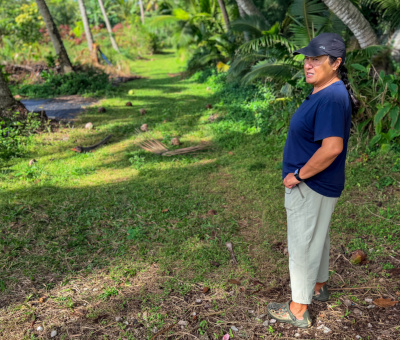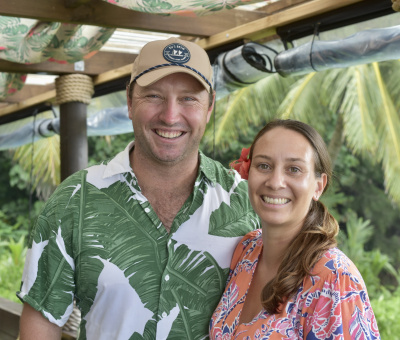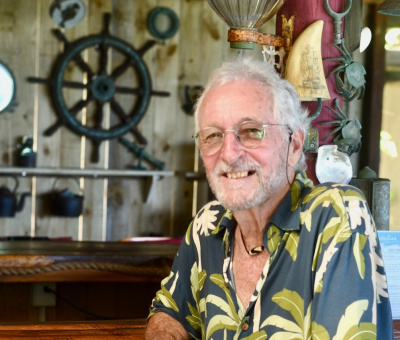
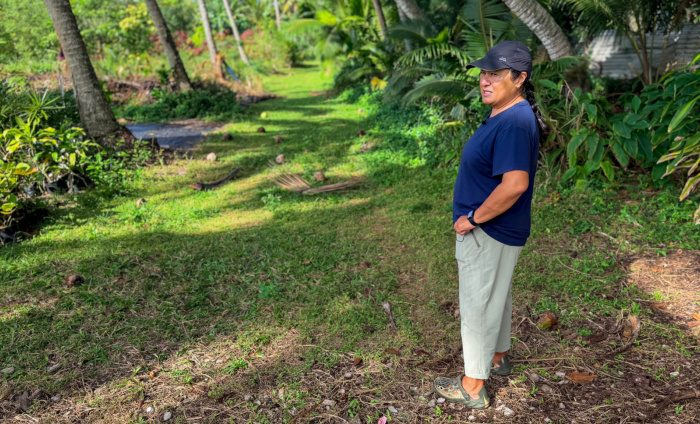
In February 2025, Karin Williams arrived in Rarotonga for the Film Raro festival, set down her two knapsacks, and came to a quiet, absolute realisation: This is where I am supposed to be. I am home.
For decades, Karin had been a formidable force on the global screen, tirelessly fighting for Indigenous storytellers to reclaim their own narratives. From her early days hammering typewriter keys in a smoke-filled Cook Islands News office to producing award-winning cinema across Los Angeles and Aotearoa, she has spent her professional life amplifying the voices of others. Yet, the physical pull of the islands—a profound sense of belonging that first sparked when she stepped off a plane in Rarotonga as a four-year-old—never left her.
Public service is deeply embedded in her bones. As the daughter of the late Sir Dr. Joe Williams—a leading medical doctor, long-serving politician, and former Prime Minister who tragically passed away from COVID-19 in 2020—she grew up witnessing a life entirely dedicated to the nation. While her father never demanded that his children follow the same path, the example was set. For Karin, returning home has been a profound opportunity to step into that same spirit of service.
Having lived a lifetime dedicated to her mother’s family in New Zealand and her husband's family in California, Karin has finally claimed this chapter for herself. She has returned to connect deeply with her Aitutaki heritage, sharing her life with her husband Nikitin, a seasoned American sailor who famously sailed a 32-foot boat from California to New Zealand as a teenager.
Yet do not mistake this homecoming for a quiet island retirement. While she laughs that she is entirely “over” the film business, Karin hasn’t stopped working; she has simply traded the director’s chair for the deck of a traditional vaka, the soil of a community nursery, and the edge of the lagoon. Shifting her formidable governance skills into what she calls the “service area,” she is now a driving force behind both the Cook Islands Voyaging Society and Muri Environment Care. Her new trajectory is guided by a singular, grounded philosophy: “We can’t change the world, but we can change our backyard.”
For all its ancestral romance, reclaiming one’s culture is not always a gentle process. Karin is quick to strip away the cinematic gloss of traditional voyaging, pointing to a recent expedition to Mauke and Atiu as one of the most physically punishing experiences of her life. Despite having navigated mountains, rivers, and vessels all over the world, she admits that absolutely nothing prepared her for the sheer brutality of this journey.
Assigned as the vaka’s First Aid Officer, Karin instead spent almost twenty-four unbroken hours violently seasick. Unable to sleep, eat, or perform her night watch duties, she found herself stripped down to her underwear, hanging over the edge of the hull and hurling into the ocean. In the depths of the nausea, she jokes that she was ready to simply jump into the water and let the ancestors take her away. It was a profound, visceral lesson in humility—a sharp reminder from those very ancestors, she laughs, not to get too cocky.
Yet, the agonising voyage also revealed the quiet, unshakable strength of the community she has returned to. When she could not stand, two women on the crew gently placed a hand on her shoulder, telling her, “We’ve got you,” and seamlessly took over her night watch. That grace carried her all the way to Mauke, where she stepped off the vaka—exhausted, starved, and still reeling—straight into a traditional island welcome. Presented with gifts, fragrant ei, and a massive feast of rich pork, Karin survived the ceremonial eating strictly by utilising disciplined yoga box-breaths.
It is precisely this resilience and quiet capability of the Polynesian people that deeply inspires her. She recalls a moment on Mauke when the crew piled into an old lorry to drive around the island, only for the vehicle to suddenly break down. As everyone climbed out, assuming they would have to walk miles to find a mechanic, one of the voyaging crew casually popped the bonnet, tinkered with the engine, and fired the lorry right back up. He had been a mechanic in a past life before returning to the islands to sail. For Karin, it was a perfect encapsulation of her people: an endless, often unassumed depth of hidden skills, quietly waiting to be called upon when the community needs them most.
For Karin, the stakes of her return are most visible in the pristine waters of Muri Lagoon—a beloved spot where she first learned to sail as a child. Today, her deep connection to these shallows drives her passionate focus on preserving their health and beauty for future generations of locals and visitors alike. Recognising that the vibrant life of the lagoon relies heavily on what flows into it, Karin is channelling her energy upstream. By actively managing freshwater streams and mountain rainwater runoff, Muri Environment Care’s work ensures that Muri remains the welcoming, breathtaking paradise people travel from all over the world to experience.
But Karin is, at her core, a mover and a shaker—an organiser who understands soil, plants, and structural systems. Long before returning to high-level governance, her path had a curious symmetry with the earth: after leaving university, she spent six months working as a labourer at the Dunedin Botanical Gardens, mowing lawns and shovelling woodchips—a humble job she completely loved.
Today, she is channelling that grounded work ethic through Muri Environment Care, actively sourcing funding from major international donor partners, including the Great Barrier Reef Foundation. Her vision for the NGO is structural: she sees a critical need to transition the group from relying on a handful of exhausted, overworked volunteers into a sustainable, multi-tiered organisation. By establishing a clear hierarchy of leadership, management, and boots-on-the-ground workers, she hopes to build a conservation machine that can actually endure. When the weight of the work feels insurmountable, she draws hope from Indigenous-led sustainability triumphs overseas, such as the entirely green, off-grid Tūhoe building in Aotearoa, which proves that radical, systemic environmental stewardship is possible.
Yet, as she looks to the future of the lagoon, Karin is fiercely protective of the history of those who fought for it first. Muri Environment Care evolved from a group of local women affectionately known as the “Muddy Buddies”—including Anne Tierney and Sonya Kamana, who now in their eighties—were out in their wellies, physically clearing the island’s streams. For Karin, ensuring their legacy is documented and honoured is just as vital as securing future funding. They are the quiet matriarchs of the island’s conservation movement, proving that the work of saving the Cook Islands’ backyard has always been driven by the relentless dedication of its people.
While her focus is now firmly planted in the soil and waters of Rarotonga, Karin’s legacy remains deeply intertwined with the screen. She entered the storytelling world in 1979 through a self-professed stroke of nepotism, landing a job at the Cook Islands News where she hammered out articles on a typewriter in a smoke-filled room. From those gritty beginnings, she built a career defined by a singular, relentless fight: demanding that Indigenous people be allowed to tell their own stories. She draws endless inspiration from trailblazers like Merata Mita and Barry Barclay—widely regarded as the first Indigenous woman and man in the world to solo-direct feature films—who paved the way through tireless, uncompromising work.
Karin brought that same fight for authenticity to her own projects. Her film Mou Piri is a masterclass in challenging the colonial gaze. Refusing the tired, commodified expectations of half-naked women in coconut bras and grass skirts, she instead presented her protagonists—two shy teenagers navigating the quiet, cultural nuances of courting—fully clothed and treated with immense respect. Partly filmed in stunning black and white, the film is a testament to her belief that storytelling is a sacred space, and that receiving someone else’s story is an absolute privilege.
Today, seeing global powerhouses like Vea Mafile’o and Chelsea Winstanley telling Indigenous stories on their own terms fills her with immense pride. Vea just got invited to join the Academy of Motion Pictures (Jonah, For My Father’s Kingdom) and Producer/Director Chelsea Winstanley recently created the Reo Māori Disney Films. We have come a long way since the early days of Mita and Barclay, and knowing the narrative is in capable hands makes it easier for Karin to fully embrace her community life and her “retirement.”
But the creative fire is rarely extinguished completely. Even as she speaks of stepping away from the camera, Karin’s eyes light up when mentioning her next act of mentorship: producing Glenda Tuaine’s first dramatic short with support from her long-term champions at Pacific Islanders in Communications. “So yeah, I guess it’s not over,” she says softly, a small laugh acknowledging that the pull of our stories is simply too strong to resist.